Filter by topic and date
IETF Meetings recording playback system now open source
- Alessandro Amirante Co-founder & CTO, Meetecho
2 Oct 2024
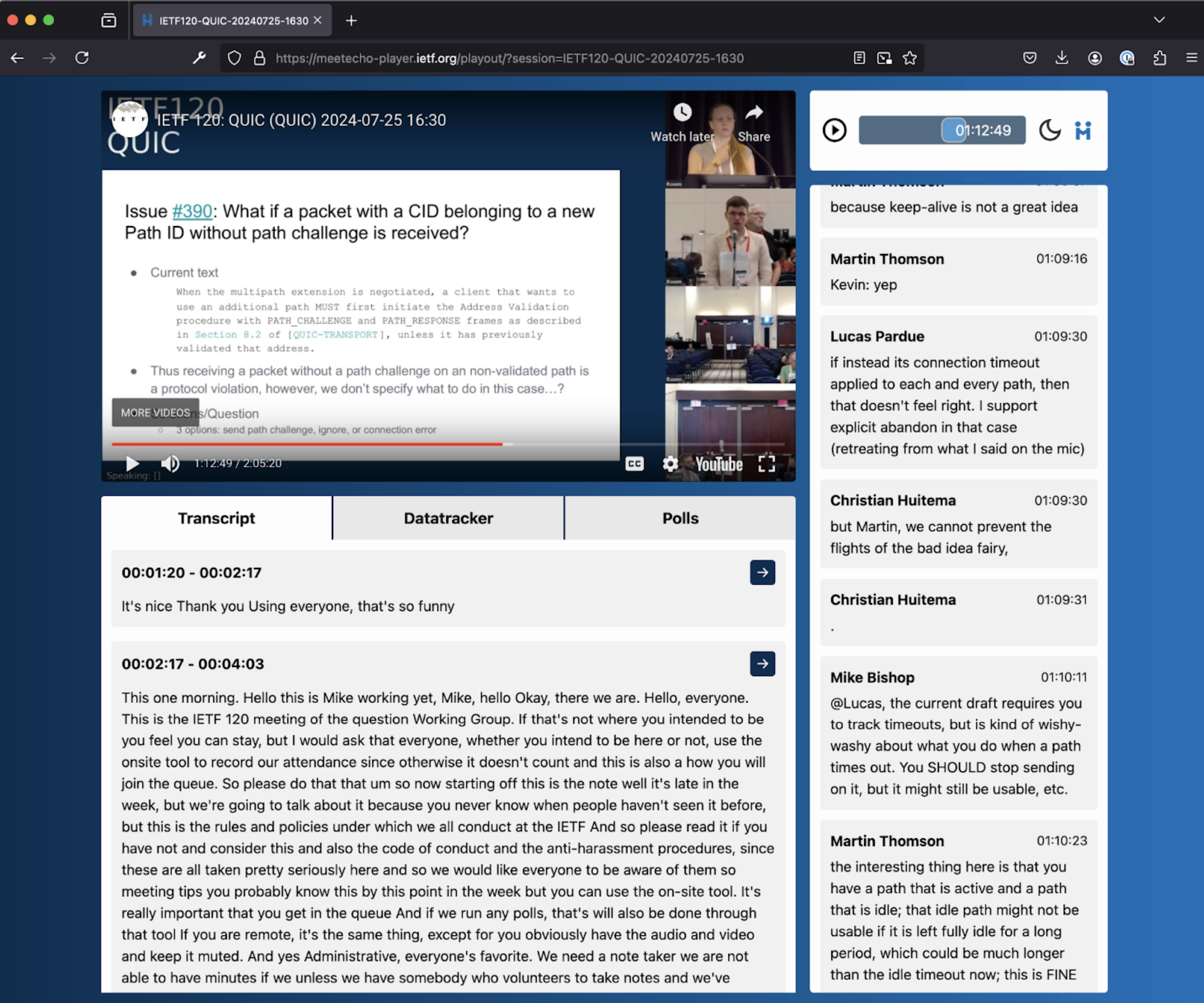
The source code of the playback system for the recordings of IETF meeting sessions was recently released by Meetecho under an open source license, and the IETF has now deployed its own instance of the system, which will be used to share recordings of IETF 121 Dublin to be held 2-8 November 2024. It can also be used to watch recordings of past IETF meetings, from IETF 98 onward.
The Meetecho conferencing system is widely used by the IETF community, including for plenary IETF meetings held three times per year as well as for many of the interim meetings held by IETF Working Groups. While real-time remote participation enabled by Meetecho is a key component of IETF meetings, access to recordings is very important as a record of the IETF community’s work. Beyond aligning with the IETF’s principle of open processes, the recordings are valuable resources for participants who wish to track discussions at meetings which they can not attend in real time.
One of the important aspects of our relationship with the IETF has been the ongoing evolution of the Meetecho system to meet the specific requirements of the IETF. For example, we have developed a specific version of the client for onsite participants, and a number of tools specifically designed for hybrid scenarios such as an integrated queueing system for both in-person and remote participants. We look forward to continuing this fruitful collaboration, providing the IETF community with this key service as part of its standards development processes.
Meetecho is also used by other technical communities, such as RIPE and other SDOs, as well as many commercial organizations. Experience with and input from communities that use Meetecho have further shaped and improved the system’s capabilities. In addition to real-time video and audio conferencing, the system provides:
- Chat
- Queue management
- Polls
- Audio transcripts
- Notepad for note-takers
The Meetecho playback system provides a record in a way that simple video recordings do not, including access to all contributions in a synchronized way that allows viewers to see what was going on at any point in time during the session.
Meetecho was born in 2009 as an official academic spin-off of the University of Napoli Federico II. From the beginning, we've been working hard on real-time multimedia applications over the Internet, ranging from VoIP to more advanced applications based on top of WebRTC technology developed in the IETF. At Meetecho, we love open source and its community. Open source drives innovation, fosters transparency, and empowers individuals and organizations alike to build, improve, and share technology. We're proud to release many of our components as open source software, contributing to the ecosystem and allowing others to benefit from our work.
We already have done this with our Janus WebRTC server, which is the media engine that bakes the IETF remote participation system, and which a lot of companies have adopted as the media foundation of their products and services. We’re now doing the same with the recording player so that the IETF can deploy its own instance and link to it from the Datatracker meeting sessions pages. We will keep on developing and maintaining it together with the IETF Tools Team, and we welcome contributions from the IETF community.